
Global Sustainability and Innovation
Solutions, engagement, education, research and implementation that enables better lives.
The Global Institute of Sustainability and Innovation brings an unprecedented unification of expertise and facilities dedicated to solve problems and sustain the integrity of our planet and its life-supporting systems through applied research and discovery.
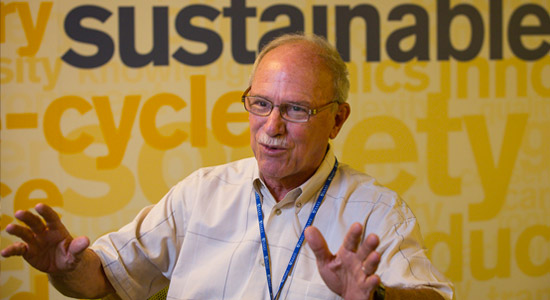
Julie Ann Wrigley, on partnering with ASU

Latest News
Osvaldo Sala co-authors article on Australian carbon plan in Science
According to Senior Global Futures Scientist Osvaldo Sala and his co-author David Eldridge, professor in the School of Biological, Earth and Environmental Sciences at the University of New South Wales, Australia’s commitment to climate change abatement is not supported by scientific evidence, which shows that increasing — not decreasing — grazing leads to more trees...
The future of US rangelands: Choices that reshape our landscape
Despite inaccurate media portrayals of sprawling, uninhabited areas, rangelands are home to 30% of our planet’s human population and 50% of the world's livestock — making them indispensable for livelihoods and food security. However, global conversations about conservation and climate change often do not mention these landscapes.
Osvaldo Sala, Regents Professor and director of the Global...
ASU Regents Professor awarded for pioneering approach to soil restoration
Arizona State University Regents Professor Ferran Garcia-Pichel was recently awarded the 2023 Theodore M. Sperry Award from the Society for Ecological Restoration during its world congress in Darwin, Australia.
The Sperry Award acknowledges individuals or institutions who have made substantial contributions to advancing the science or techniques used in restoration practice. In this Garcia-Pichel's case, the...